| Rocchini Dumas Collections - Almenno San Bartolomeo (Bg) Italy | Gianfranco Rocchini grocchini@inwind.it |
| - Introduction - | Update 12/07/2022 |
| - Some note on baltic amber - |
| - Books new entry - |
| The published inclusions are part of Rocchini Dumas collection; the content and the photos are freely usable. |
| - Other Collections: Ancient Medical Instruments Member of European Association of Museum of the History of Medical Sciences - E.A.M.H.M.S. Paris. | |||||||
|
| Introduction |
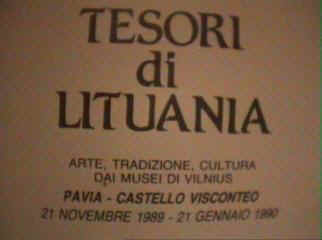 |
In november ’89 my wife and I
went to Pavia and the Visconti
Castle, where we visited the exhibition “The
Treasures of Lituania”. There I
got in touch for the first time with baltic amber and started my collection. At first I bought each and every piece of amber I could get hold of, whatever it included. By now I am more selective, in order to avoid similar pieces, although every piece of amber is unique. Furthermore the price for baltic amber has considerably increased. I prefer to buy amber from Polish hawkers here in Italy, as their amber is unpolished or partly finished and has not been subject to thermic treatment. In Paris Russian traders from Kaliningrad always offer quite interesting (and expensive) pieces. Yet they were all treated thermically in order to increase their transparency, very often to the detriment of the inclusions. My
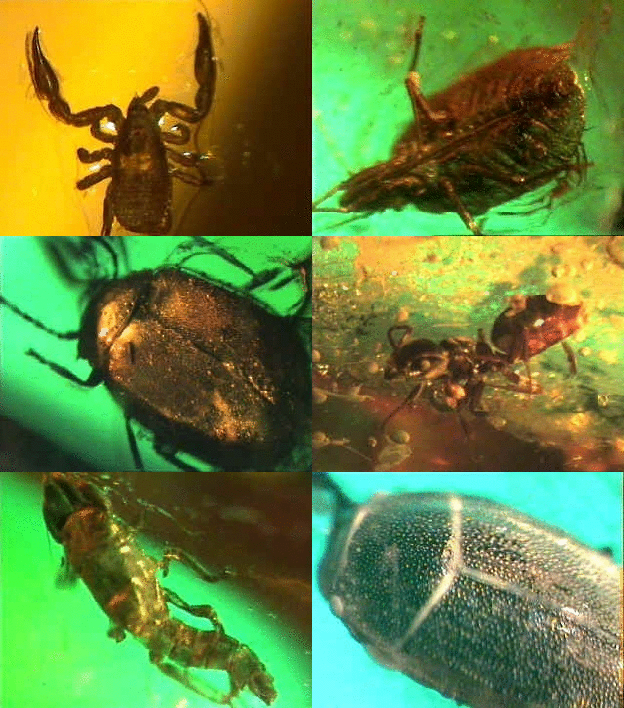
collection contains about 1000 pieces, most of these include diptera ( the most
common insects in baltic amber). There are yet some rather rare and interesting
pieces which you may find on the picture page. This publication is meant to intrigue its readers and tempt them to start a collection of their own, as well as to get in touch with whoever is interested in exchange of ideas and information. Last not least I meant to satisfy that tiny part of exhibitionism burried in the subconscious of every collector. |

| Some notes on baltic amber |
 |
 |
|
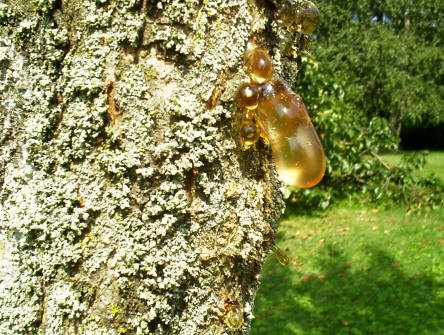
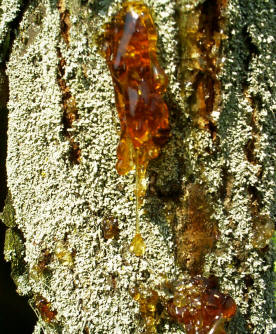
Resin exited from the trees of my garden….. perhaps between 40 million years will become amber..... |
|
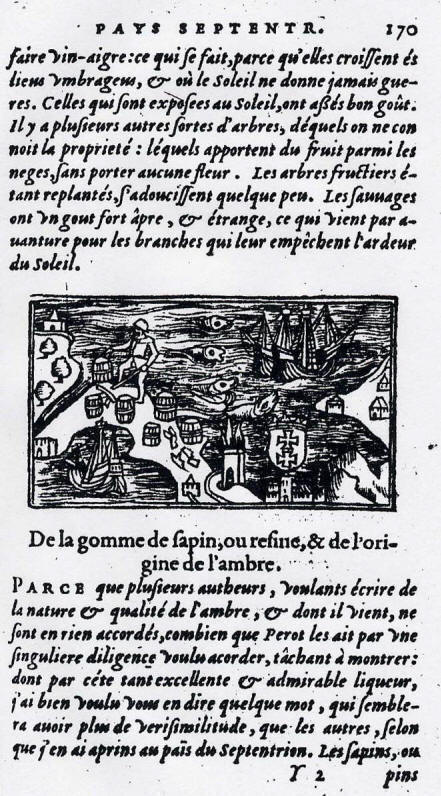
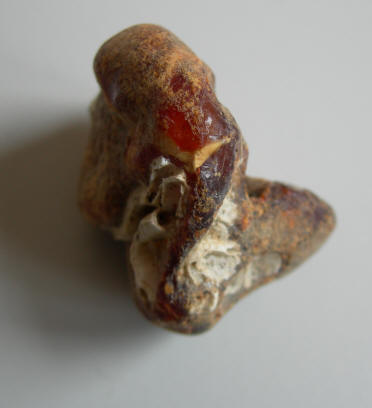
Baltic amber is a resin produced about 30 to 40 million years ago by a pine tree by now extinct, pinus succinifera, that grew in territories now invaded by the sea (succinum is the old latin world for amber, electrum the greek one). For further details and information please see “web sites on amber”. |
|
During
violent storms the amber, burried under layers of earth and sand, is torn out
the seabed (thixotropie) and deposited on the shores ( the
specific weight of amber is between 1,05 and 1,10). Since times unknown people pick it up and put it for sale. In the late 1600 consistent deposits were found inland. These are still active and furnish most of the amber on the market today. This amber is quite soft, about 2,5 Mohs, thus easy to work. It has been used since prehistoric times to create small objects and jewelsSince ancient times the amber was claimed to have healing capacities and magic power, for instance for its capacity to attract hair or wool when rubbed (the principles of electrostatics yet unknown) and the mysterious presence of parts of plants or small insects. Although most of its secrets have been unveiled the amber is still object to empiric practices, as remedy for impotency (just keep a piece of amber in your pocket !) nervous or digestive disorder or as ingredient for beauty creams. According
to ancient arab belief amber prevents the transmission of contagious
diseases one might be infected with
due to the promiscuous use of the water pipe. Therefore amber is still used in
mouthpieces for pipes or cigarette holders. The American Museum of Natural History entitled its web page on amber “Amber, Window to the Past”, summarizing very well the emotional and scientific content of this warm “stone”: through this window you may bring to life again the tragedy of the small insects trapped in the amber, know their habits, their environment, the vegetation, climate and with a little help of your imagination find yourself in this world gone by long ago.
|

|